
Top news
No. 22
A single agent with fresh restarts beats agent swarms at equal budgets
Teams of AI agents working together, often called swarms, have grown from a handful of agents to thousands in under a year, and labs now report team results beside single agents. A new study by Paradigm 3 asked whether adding agents makes the work better or only makes it faster.
Given the same total budget, teams of two, four and eight agents finished several times sooner than one agent but scored a little lower. Their one apparent win disappeared once the single agent could start fresh sessions that kept only the files on disk. For now, a swarm buys speed at a cost in tokens.
At matched budgets, no swarm clearly beats a single agent
Anthropic finds companies gain most from AI after reorganizing jobs around it
Anthropic's researchers interviewed people at dozens of companies that use Claude, from law firms and dentists to hedge funds and a trucking company, to learn how AI is changing their work. The report gathers their stories into a picture of where AI pays off and where it stalls.
People described very few layoffs caused by AI, but most companies said they were hiring less, and many had cut offshore contractors. The biggest gains came where companies changed jobs around AI, giving people whole workflows, moving staff to the tasks AI cannot do yet, and opening company data to everyone.
A small forecasting agent rivals Fable's accuracy at a fifteenth of the cost
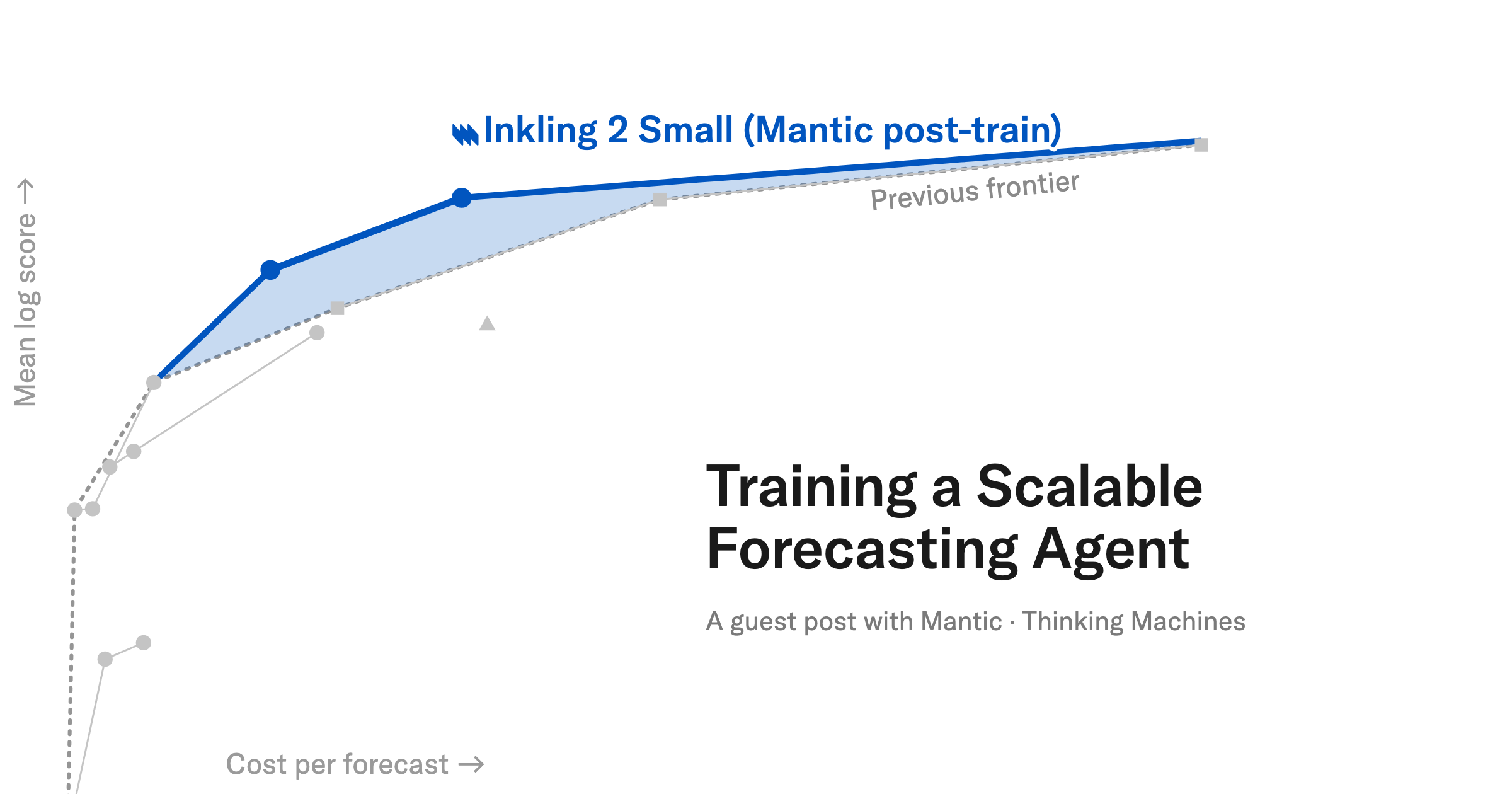
Prediction markets cover about a thousand serious questions, far fewer than businesses and governments would like answered. Mantic, an AI forecasting company, worked with Thinking Machines to train a small model that researches a question and then gives a probability forecast, all in one run.
The trained model is about as accurate as a leading frontier model at a small fraction of the cost per forecast. Getting there took three fixes: writing training questions from the news, serving historical data fast enough for thousands of runs at once, and a reward that luck sways less.
Deep dive
Agentic memory
Agent memoryContext and memory
Google's Agent Retrieval now turns a bucket of files into cited search results
Agents that answer questions from a company's own files need a pipeline that reads the files, cuts them into pieces and indexes them for search. Google's Agent Retrieval service can now do all of that itself, from documents and videos stored in Google Cloud.
One call returns the matching pages or video moments, each with the file and the page or time it came from, so an agent can cite its answer. The feature is in preview, carries no charge of its own until general release, and runs in two regions.
In brief
Frontier news
Claude Code adds a hook that can refuse a skill's shell commands (opens in a new tab)
Skills can carry shell commands that run the moment the skill loads, so a shared skill can act on a machine before anyone reads it. Claude Code's release of 25 November adds a hook that can refuse those commands, along with early support for skills served by MCP servers and fixes for failed compaction. Teams that share skills get a check before skill code runs.
Labs have released several AI-made math results this month. Google Research posted papers produced by Cogentic, its agent framework built on Gemini, including a paper on factoring whole numbers whose full proof, it says, was also checked in the Lean proof assistant with no human help beyond the opening prompt. Agent builders get a case of long work checked by software instead of reviewers.
Teams of research agents struggle to check each other's claims. Google DeepMind ran separate teams of Gemini agents on quantum algorithm problems, let an idea into their shared notebook only after it passed a Lean proof, and had the teams meet regularly to trade ideas. One result cut a circuit's computing cost nearly twelvefold. A formal checker can guard what agents share with each other.
Agents at work
Hugging Face reports what broke when its agent swarm grew to a thousand (opens in a new tab)
Little has been published about running agent swarms at scale. Hugging Face grew a swarm to a thousand DeepSeek agents that built a chatbot in plain Python, and reports what broke: most merges failed as the main branch raced ahead, summarizing context cost more than talking, and one agent scanned ports when Git went down. Swarm builders get fixes and a warning about unwatched agents.
Claude Ship hands the work after a pull request to agents that review, fix and watch it, so teams need a place for house rules. Addy Osmani's guide on the claude.dev blog maps each kind of rule to its file: coding conventions in CLAUDE.md, review rules in REVIEW.md and upkeep habits in the steward skill. Feedback reviewers keep repeating becomes a written rule.
Agents that write their own scripts for specialist science tools often trip over messy real data. Google DeepMind's Mass Spec Skills for Antigravity wrap proven, openly available chemistry tools as skills, and with them a light Gemini Flash model identified molecules as accurately as frontier models while writing far fewer tokens. Packaging proven tool steps as skills can make a cheaper model good enough.
Patrick McKenzie shows what a day of running many Claude agents together costs (opens in a new tab)
Running more than two or three coding agents at once quickly outgrows a terminal. Patrick McKenzie describes Grimm, a hedge fund's internal tool that puts many Claude agents in one shared machine where they talk to each other, and reports a day spent speeding up deploys on an unfamiliar system for $823 in inference. Teams get a priced account of managing agents like staff.
Agentic memory
Beihang's TASK memory steers models to trust retrieved notes over stale weights (opens in a new tab)
Agents often find the right note in memory and still answer from an outdated fact learned in training. Beihang University's TASK memory pairs each note with a removable edit to the model and a signal that decides whether the model should trust the note. Such errors fell to at most 1.5% in every test. Memory builders get a fix for ignored notes.
Agents that learn from past runs can keep lessons from successes, failures or both, but few studies separate what each adds. Microsoft researchers built DualPM, a simple memory that keeps both kinds of lesson and merges them to stay within a fixed size. Lessons from failures helped agents handle more tasks, while lessons from successes made them more efficient. Keeping both pays off.
Graphiti stops memory lookups by ID from reaching into another group's graph (opens in a new tab)
Graphiti, the open-source knowledge graph behind Zep's agent memory, splits memory into groups, often one per customer. Its release of 24 November closes a gap, found by Codex Security, where fetching a memory by its ID could reach into another group; such calls now fail without reading or changing anything. Teams that serve many customers from one shared graph should update soon.
Tools
Developer toolsAgent harnesses
Vercel's Workflow SDK now runs safe-to-repeat steps early to speed up agents (opens in a new tab)
Agents built on Vercel's Workflow SDK survive crashes because each step is saved, but the scheduling between steps adds delay across long tool loops. The release of 25 November runs steps that are safe to repeat ahead of time, cutting the delay between steps about twelvefold, and never repeats steps marked as not retryable. Agent builders get faster turns without rewriting their code.
Developer toolsCost and routing
Agents working on Cloudflare used to stop and send people to the dashboard whenever a task needed a paid plan. Its command-line tool and MCP servers can now switch on usage-billed plans, and in agent apps that support it, Cloudflare first shows the price and asks the person to approve. Agent builders get a working pattern for spending approval inside the conversation.
OpenCode can now run prompts on a schedule or when MCP servers push events (opens in a new tab)
Coding agents mostly wait for a person to type before they act. OpenCode's release of 23 November adds automations that run a prompt, script or shell command on a timer, a schedule, or an event sent by an MCP server, with shell actions approved once when created and every run logged. Developers get an open-source way to tie recurring agent jobs to live signals.
Local and home
llama.cpp can now shrink a model to fit an exact file size (opens in a new tab)
Fitting an open model onto a home GPU usually means trying fixed compression presets until one fits. The new numbered version of llama.cpp can compress each part of a model separately to hit a chosen file size, supports Thinking Machines' Inkling models and adds a redesigned chat page with voice messages. Local runners can fill their memory exactly instead of guessing.
A bootable kernel in pure assembly runs a small Qwen model without Linux (opens in a new tab)
Running a model at home normally rests on a full operating system, a runtime and many libraries. The llm.asm project boots straight into a chat with a small Qwen model from a kernel written entirely in assembly, on bare hardware or in a virtual machine. Home-lab tinkerers get a clear picture of how little a language model needs to run.
KRAFTON releases a freely licensed agent model sized for a single RTX 5090 (opens in a new tab)
Many open models built for agent work need data-center GPUs, which keeps them out of home labs. KRAFTON, the games company, trained its Raon model from scratch and released it under the permissive Apache license, with tool calling for Hermes Agent, Pi and OpenCode and a draft model that speeds up replies. Home-lab owners get an agent model sized for a high-end gaming card.
Security and trust
Attackers increasingly run break-ins through open-source hacking tools that let a language model plan each step. Wiz found that two of them, ARTEX and Cairn, give the model a running Intent ID, which then leaks into the victim's records, such as comments on cloud commands and the names of cloud resources. Defenders get a concrete sign of an agent-driven attack to pair with other evidence.
The newest closed frontier models are offered for offensive security work only through approval programs. A Security ran several models through its multi-agent hacking setup against generated vulnerable web apps, and DeepSeek's Flash model found the most confirmed flaws at a fraction of the closed models' cost per finding, with Z.ai's GLM close behind. Defenders should assume freely downloadable attackers are this capable.
The ruflo agent orchestrator gives its MCP bridge the provider API keys, a terminal tool and a shared learning store. A critical advisory shows its default Docker Compose setup exposed that bridge with no login, so anyone on the network could run commands, read every key and plant poisoned patterns that steer later answers. A patched redeploy leaves planted memory behind, which operators must clear.
Research
Parallel subagents raise coding pass rates slightly at up to 3.8x the cost (opens in a new tab)
Codex and Claude Code can hand coding work to subagents in parallel, which multiplies cost. University of Illinois researchers found they raised pass rates only slightly on tasks that build repositories. One sentence telling a lone agent to probe the reference program first recovered most of the gain, and agents that restarted fresh made faster early progress. Teams should try those cheaper fixes first.
Teams add AI reviewers to keep up with coding agents, and effort settings trade cost for care. Researchers at Trust My Bot had Claude Opus, Sonnet and Haiku review the same agent-written Django patches at low, medium and high effort. Higher effort caught more wrong patches, yet every setting accepted at least 45% of them. A lone AI reviewer makes a weak gate before merging.
NVIDIA finds some models manage their own context better than the harness does (opens in a new tab)
Agent harnesses usually decide when to shrink a full context window by summarizing the history. NVIDIA researchers instead gave models tools, in their open-source NOOA harness, to fold away and fetch back their own history. OpenAI's GPT-6.1 nearly tripled its score when space was tight, while Opus rarely used the tools. Harness builders can hand context control to models that use it well.