
A small forecasting agent rivals Fable's accuracy at a fifteenth of the cost
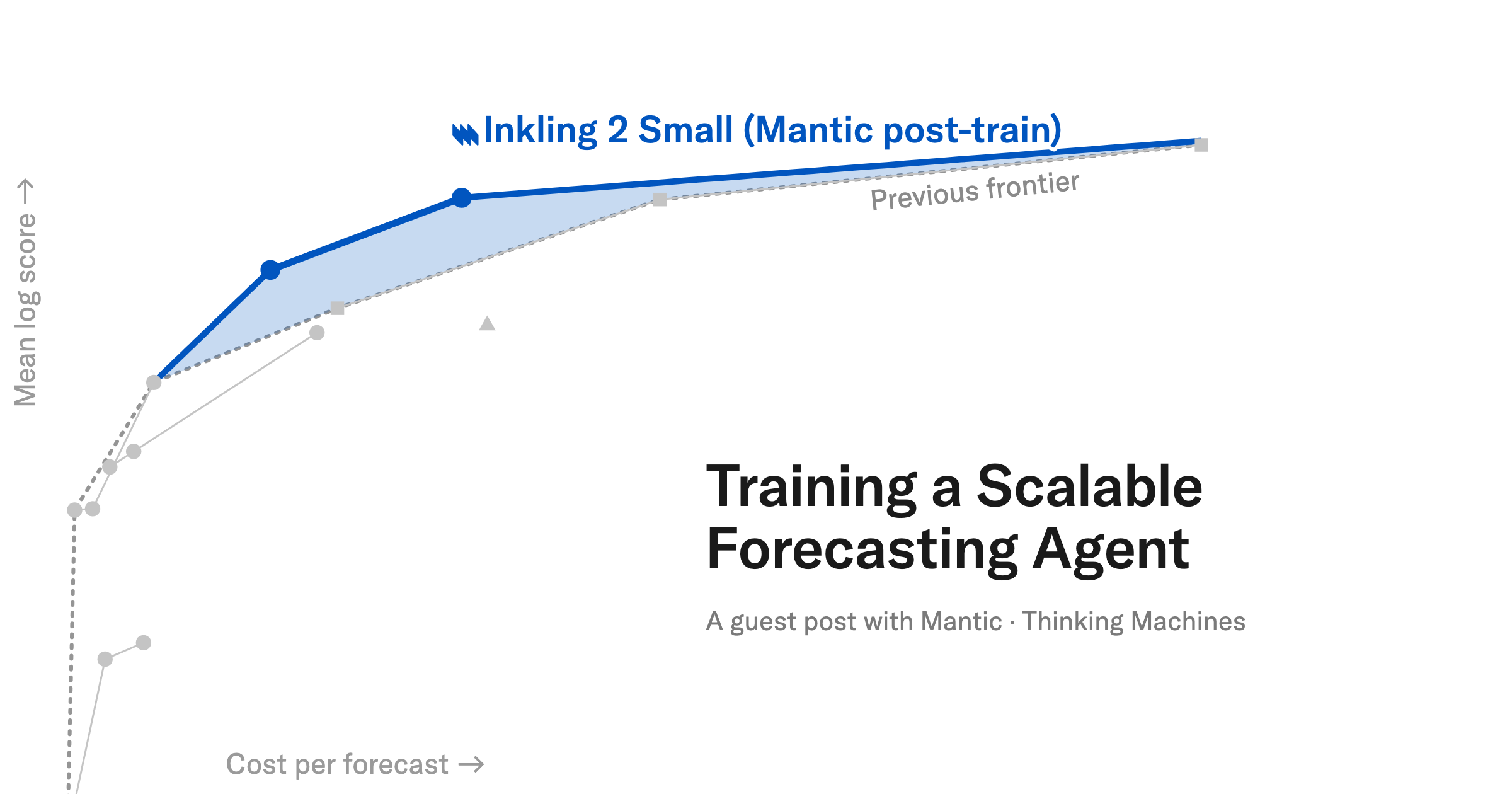
Mantic, working with Thinking Machines, trained Inkling 2 Small on the Tinker platform to research and forecast in a single agent run. On 200 held-out questions it scored about as well as Fable 5.2 at medium effort for 15 times less per forecast, cheap enough to make 100,000 forecasts about S&P 500 companies.
Major prediction markets carry about 1,000 interesting questions about world events, while the number of forecasts that would be useful to someone is far larger. Mantic, an AI forecasting company, wants to close that gap with machines. In the summer, its system was one of two AI systems that beat all of the more than 600 human forecasters in the Metaculus Cup, a first for AI. Its new work, a guest post on Thinking Machines' news page dated 24 November, is about doing that cheaply.
Mantic trained Inkling 2 Small on Thinking Machines' Tinker platform to do both halves of forecasting, research and prediction, in one agent run. The agent gets a question and tools to search data from the time the question was asked, run code and submit a probability distribution. On 200 held-out numerical questions from Metaculus, Polymarket, Kalshi and Mantic's own platform, all asked after the model's knowledge cutoff, it was roughly as accurate as Fable 5.2 at medium effort and 15 times cheaper per forecast.
The first problem was a shortage of questions. Of about 848,000 numerical questions resolved on Metaculus, Polymarket and Kalshi in 2026, about 304,000 were left after removing duplicates and only about 3,900 after removing off-topic and low-quality ones, such as sports, crypto prices and what someone will say. Mantic built a system that writes forecasting questions from the news and produced 45,000 of them. Gains on these questions carried over to the real ones from prediction sites.
The second problem was speed. The agent's research tools must return only information available when the question was asked, and calling outside data services at training scale would, by their rate limits, have taken about nine years. Mantic instead copies the data into its own fast databases. One holds Wikipedia's complete revision history, 1.32 terabytes of indexed text, so the agent can search Wikipedia as it stood on any past date and read a batch of old pages in one query.
The third problem was luck. On any single question, an overconfident forecast can beat a well-calibrated one; in Mantic's simulation, the overconfident forecast scored higher 60% of the time yet lost on average. So the reward mixes the score against the real outcome with the expected score under a reference forecast made by a group of frontier models. The reference reflects only what the agent could have known. The trade-off is a pull toward the frontier models' mistakes, which the real-outcome part keeps in check.
Training ran as reinforcement learning across thousands of runs at once, using StableReinforce, a Tinker method that keeps long runs stable and made experiments three times faster. The harness was kept light, so the agent would find its own strategies. Over training, research and modeling became more common. At high effort, the agent behaved more like a quantitative analyst, researching thoroughly and writing code to analyze data before settling on a forecast.
One example shows the change. Asked for a Korean producer price index for coal and petroleum products in August 2026, the untrained model made 25 tool calls, drew one straight line between the index and the oil price, and expected a steep fall. The trained model made 49 tool calls, found that refinery price caps were frozen and a fuel-tax cut ran to the end of July, modeled the index month by month, and tested its estimate against the 2022 oil crash before forecasting a slow decline.
Mantic plans more forecasting-specific training, better ways to reward long tasks, larger datasets and more compute. The results come from the authors' own tests, and the post compares cost and accuracy on one held-out set of questions. As a demonstration of scale, the team made 100,000 forecasts of 2027 revenue and earnings for every S&P 500 company under 50 scenarios, each made both as if the scenario happens and as if it does not.